


04 Mar 2026
.jpg?w=640&hash=14E0FC415F03FD40AE5E186600A160C4)
Arts Development Update is our bi-monthly blog sharing insights from our arts practitioners, capability support and ideas and partnerships driving the mahi. In this blog, we turn our attention to audience engagement.
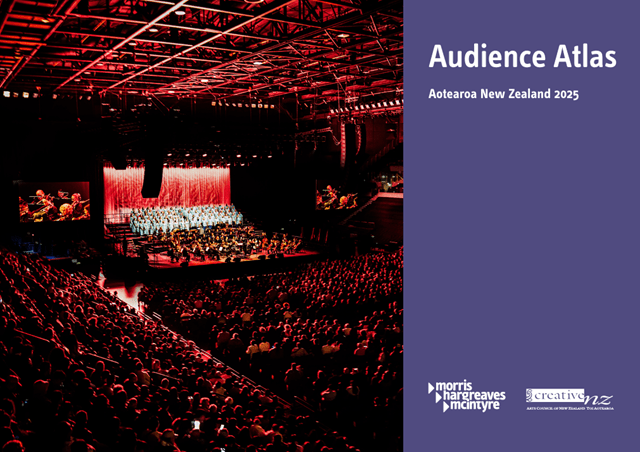
The latest insights from Creative New Zealand’s Audience Atlas Aotearoa 2025 offer a window into changes in audience behavior and trends post-COVID. Audiences report they are likely to be attending less frequently than previously and are becoming more discerning. So how do arts organisations persuade audiences to choose their arts experience over other activities. We asked Te Ahurei Toi o Tāmaki Auckland Arts Festival (AAF) to share their insights on audiences and the report findings. For AAF, audience experiences vary. Vanessa Zigliani, Head of Business and Finance, explains some of the barriers for audiences.
"In our AAF 2025 post-festival survey we asked non-attenders their main reasons for not attending. Nearly 47 per cent of respondents said cost of living pressures affected their budget, while 30 per cent felt tickets were too expensive. A further 17 per cent didn’t know what was on, and 27 per cent said there were no shows they wanted to see. Health reasons and competing priorities also played a role," she says.
What does this tell us?
It tells us audiences are not disengaged — they have become more deliberate about the choices they’re making – both with their time and money. They are weighing up their options carefully. In some cases, it’s not a ticket price problem per se, it’s the perception of value – audiences aren’t sure of the value of the experience relative to other leisure experiences.
The festival’s insights show an ongoing shift in audience behavior. Loyal festival-goers continue to book early when the programme launches, but many attendees are now purchasing closer to the event.
Is it economic caution or simply a desire for flexibility?
AAF suggests it’s a combination of both. In a climate shaped by uncertainty, audiences are taking longer to commit, showing that engagement is not just about creating excellent work, it’s about understanding what persuades people to come via programming, communications and relationship building.
When it comes to loyalty, the picture is nuanced. The 2025 post-festival survey showed 79 per cent returning attendees and 21 per cent first-time attendees in 2025. Yet year-to-year comparisons indicate that only around 20 per cent are consistent returners, with 80 per cent effectively new audiences each season. Loyalty, it seems, cannot be assumed. It must be rebuilt each year.
And this is echoed in the Audience Atlas findings which show that 6 people in 10 are seeking ‘deep fulfilment’ – intellectual, emotional or spiritual – to feel a sense of belonging and identity. Post-COVID, people are looking for things that allow them to escape and switch off from digital devices. Those organisations that are successful in doing this are building loyalty and the habit of re-attendance.
In recent years, donor growth has slowed and some long-term supporters have reduced their support. The AAF has leaned into relationships and launched a Friends membership, bringing in more than 150 people seeking a closer connection.
AAF notes that reaching culturally diverse communities remains an ongoing challenge. At the same time, the Atlas report shows that Pacific audiences are more likely than most to have spent money on the arts, volunteered or donated. Equally, and in contrast to this, they were more likely to feel like they don’t ‘fit in’ when asked what prevents them from attending. The AAF team says they are continuing to build engagement levels to fully reflect the diversity of Tāmaki Makaurau and connection depends on working alongside trusted community members and genuine outreach.
Vanessa notes AAF has also adapted its communication approach. By investing in artist-led video content and focusing on storytelling rather than constant ticket selling, the festival has seen a significant uplift in organic social media reach. Email remains a key channel, but the focus is now on sharing voices and creating genuine connection.
Audience Atlas findings also show personal recommendations are key and interestingly there’s been a decline in the influence of social media (down from 51% in 2020 to 36% in 2025 as the main information source) partly due to the diminishing quality of social media content. However, video and audio content have increasing influence especially in connecting with people who are ’like me’.
In essence, information matters. Price matters. Timing matters. But connection is key!
Looking at Audience Atlas Aotearoa 2025 through the AAF’s lens shows that in a post-COVID context the message is clear: knowing your audience and responding meaningfully helps both attendance and the sustainability of the arts across Aotearoa.
Read the full Audience Atlas Aotearoa report 2025 and companion reports on our website.
Watch the webinar with Andrew McIntyre for more practical tools to help you turn audience insights into action: