

30 Sep 2025
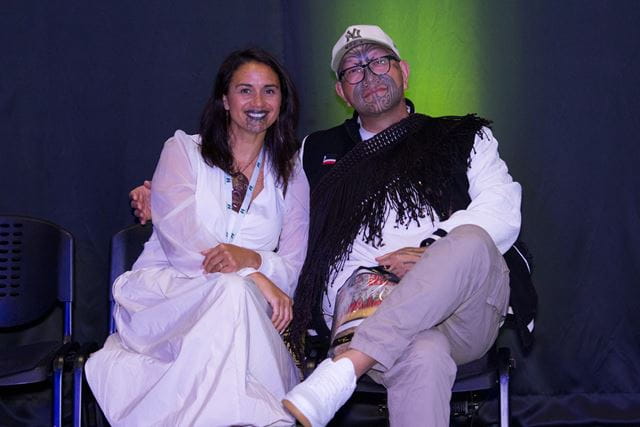
Belting out a waiata as he took centre stage, singer-songwriter and activist Rob Ruha (Te Whānau-ā-Apanui, Ngāti Porou) set the tone for day two of Nui te Kōrero 2025 with humour and heart. His laugh rang through the hall, welcoming the audience into his kōrero.
One of the key focus of this year’s wānanga was how can ngā toi and the arts can be positioned as central pou in shaping creative economies that unlock potential, grow participation, and strengthen opportunities locally and internationally.
This was not just a theme for discussion, but a lived reality, woven through Rob’s work as an artist, mentor, and cultural leader.
As kaikōrero, Rob turned the spotlight directly on the place of artists within those economies. He challenged the room to recognise that creatives are already carrying immense responsibilities. Their role is already critical, breathing life into culture and creating spaces where people can see themselves reflected.
“Why do we have to do the money as well?” he asked.
For Rob, the answer lies in having a purpose and a values-based approach to growing creative economies.
He pointed to kapa haka as both a solution and an enduring foundation. Far from a niche practice, it has always been central to Māori identity and survival, carrying reo Māori, weaving, tā moko, carving, and other taonga important to Aotearoa.
“Kapa Haka is popular culture in Aotearoa. It is the mothership of reo Māori. Growing up, I kept hearing dismissive comments that kapa haka would ‘get you nowhere.’ That seems to still be the rhetoric today.”
“But kapa haka continues to fuel our power. Through kapa haka, generations have found discipline, resilience, ōranga, and pride,” he says.
Rob sees creative economies are not only about financial models or industry systems. They are about ōranga for tangata whenua and Aotearoa. The arts are vessels of healing and collective strength. They restore balance where systems have eroded mana, reconnect whānau with whakapapa, and remind communities of the value they already hold.
“Who is your audience? For me it’s about understanding that. For creatives, it should be less about asking, ‘How do I get my stuff out there?’ and more about ‘Why? What story do you have to tell, and why?”
His message was simple yet profound: purpose must come before platform. When artists know their story and their reason for telling it, the work will carry its own mana and reach. When taonga such as waiata, kapa haka, weaving, carving, and visual arts are placed front and centre, the wider economy begins to orbit around culture — not the other way around.
“How do we make it work? Kotahitanga” he urged. “And if you’re not on board, you’re in the way!”
His challenge to the sector is clear: support the arts— spiritually, financially, through your time and energy, and in doing so, support the growth, mana, and ōranga of the people of Aotearoa.