

26 Sep 2025

Nui te Kōrero, our biennial arts conference, was held in Tauranga this year in collaboration with ngā Iwi o Tauranga Moana (Ngāpōtiki, Ngāti Ranginui, Ngāiterangi, Ngāti Pukenga ki Ngāpeke).
The theme was ‘Kia kotahi te tū: Standing together for the arts’.
Keynote speakers, presentations and activities explored the theme through four lenses:
- Equity & inclusion – How do we ensure just outcomes through partnership, policy, and action, honouring Te Tiriti o Waitangi?
- Accessibility – How do we centre community experiences to embed access for all, especially for tāngata whaikaha, tāngata turi, Deaf and disabled artists?
- Emerging technologies – How do we harness AI and innovation while safeguarding IP, mātauranga, and artistic integrity?
- Creative economies – How can ngā toi and the arts be positioned as central pou in shaping creative economies that unlock potential, grow participation, and strengthen opportunities locally and nationally?
Over the coming months, we’ll reflect on the kōrero with stories about what was shared and what has happened since.
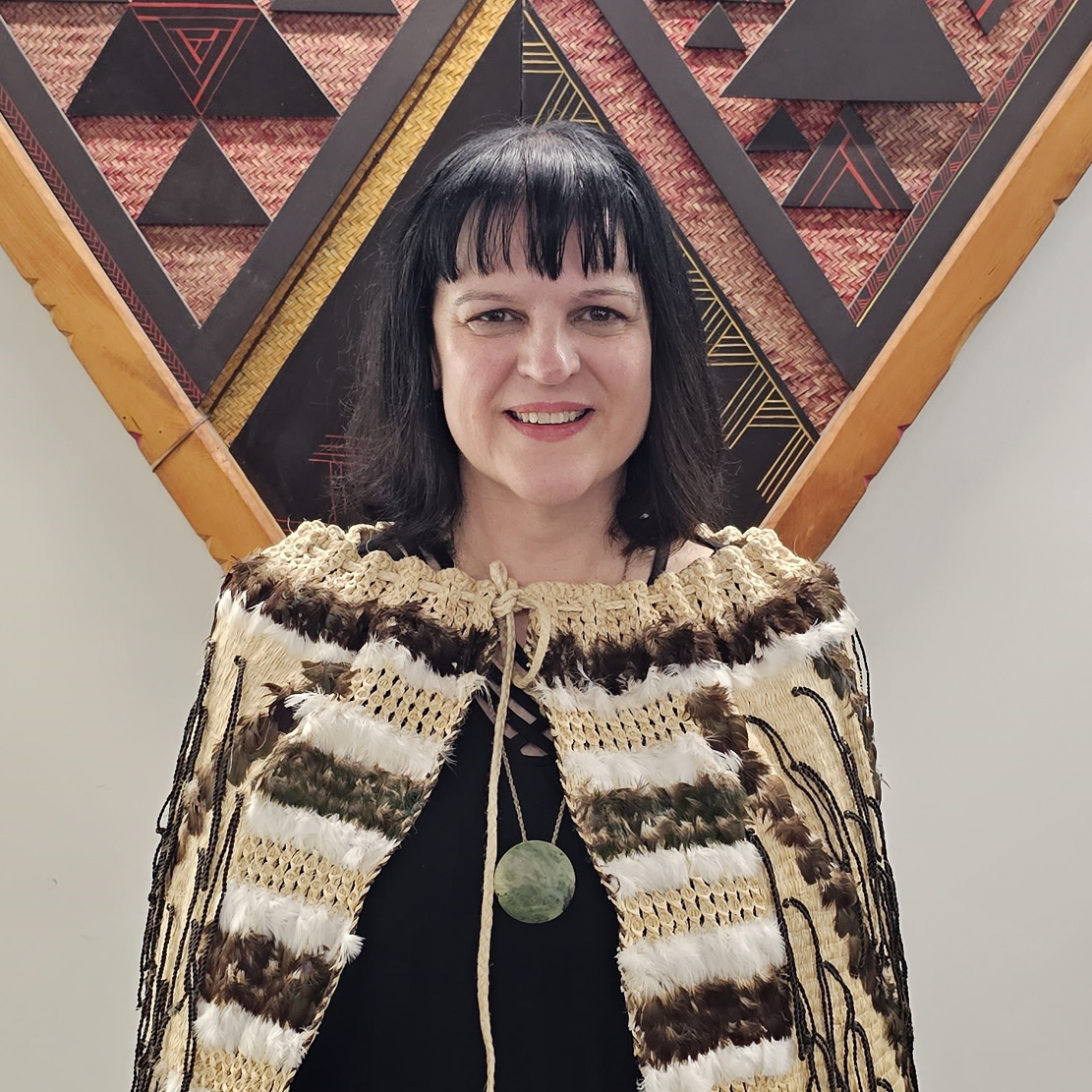
We’re starting this reflection with a transcript of the opening address by Gretchen La Roche, Tumu Whakarae of Creative New Zealand.
E aku nui, e aku rahi
E aku whakatamarahi ki te rangi,
E aku whakateitei ki te whenua
Tēnā ra koutou katoa
Tuatahi e tautoko ana, i ngā mihi, kua mihihia e Kura, e Shane
Waimarie tātou kua tau ra te waka o Te Ao Toi, ki roto o Tauranga Moana, mō Nui te kōrero – Kia Kotahi te tū
Nā reira Ngāti Ranginui, Ngai Te Rangi, Ngāti Pukenga, Ngā Pōtiki
Tauranga Tangata, Tauranga Moana, kua Rangatira tātou katoa ia koutou.
E mihi ana, e mihi ana
Ko wai au?
Ko Titirangi te maunga
Ko Turanganui te awa
No Turanga-nui-a-kiwa ahau
Kei te noho au ki Tāmaki Makaurau
Ko Gretchen La Roche ahau
Ko au te Tumu Whakarae o Toi Aotearoa
It gives me the greatest pleasure to welcome you all here today. As I scan around, I can see a lot of familiar faces and some I’m looking forward to meeting and getting to know.
I hope you enjoyed the video; part of Creativity makes us – Auahatia! This campaign has been viewed over 1 million times to date. It’s a great indication of the work that is going on in the advocacy space, but more to come.
Today I note, is a very auspicious day, not just because we’re here, of course, but also because voting opens in Local Government Elections. You’ll be hearing more about the Local Government campaign that Te Taumata Toi a iwi and Creative Waikato are undertaking called Creativity Belongs Here. And I really hope that you engage with that. I think it’s a terrific campaign – I say in a politically neutral voice, of course!
Ngā mihi nui, thank you
I’d like to start with a few thank-yous. As we know in this business, these things don’t come together easily. I’d like to acknowledge again our extraordinarily talented co-curators, Ria Hall and Henrietta Bollinger who have helped make this programme possible. We really hope that you find this a terrific two days that enriches you.
I’d like to acknowledge all our kaikōrero who said yes and agreed to share their knowledge, insights and inspiration. I have to say it is quite daunting standing up here as well. Also, big ups to you for coming along and doing that, thank you.
Thanks to Tauranga City Council for the welcome lunch, telling the story of cultural transformation and for your generosity, especially to Gareth Wallis, Reena Snook from Baycourt Community & Arts Centre.
And to our venue partner Mercury Baypark for hosting us across the two days.
To our function partner, The Incubator Creative Hub, for their hospitality that you’ll be enjoying tonight and the carnival vibes that they’ve promised.
We acknowledge the talented folk at Composition, our event management company, who – as their name suggests – have helped us bring all the parts together.
And I’d like to make a special mention and shout out to our Manga Tipua reference group, who have helped us make Nui te Kōrero 2025 a more accessible event.
This is my first address, in my current role as Chief Executive, to you all. I feel incredibly honoured to have the opportunity to do this. I’m very aware of the expectations out in the sector of the work that we have ahead of us. I also want to take a moment to pledge my commitment to you to offer my very best over the years to come.
I want to acknowledge the great support I’ve had from Kent [Gardner], as my Chair, my boss. I realised I have three bosses. I haven’t quite worked out how I managed to do that: the Chair, the Chief Executive of Ministry for Culture & Heritage, Mac [Leauanae Laulu Mac Leauanae], who’ll be joining us tomorrow, and the Minister [Hon Paul Goldsmith]. I particularly want to thank all of you for the support and encouragement I’ve had coming into this role.
Nui te Kōrero is our time
The significance and importance of coming together here: Nui te Kōrero. I want to acknowledge the effort that everyone has made in coming together. You all have a lot on; it means a lot that you have taken the time, to step out for three days to be together. I also want to acknowledge in these times that it’s not only a demand on time but there’s also a cost to be here. We really appreciate that and are conscious of that as we’ve put the programme together.
But the value, as we’ve already heard, is the occasion to gather, share ideas, be inspired and challenged. Importantly perhaps to test our thinking, form new networks, find potential partnerships, future collaborations, and alliances and to support each other.
This is the only event like it, where creatives, artists, practitioners, arts managers, governance, enablers and supporters across artform and practice and geography come together.
This is our space; it is our time. It is the invitation to step away from the day-to-day, to test our assumptions, perhaps our treasured truths, and to be open to new possibilities.
So there are several hopes for this conference that I put to you, and the first is that perhaps you step away from this, not necessarily with a shopping list of new things and ideas, but maybe the one thing, the one new idea, the action to implement or use as a catalyst to move your thinking, your practice, your organisation forward.
Two, that you leave with a sense of being part of something greater than ourselves, supported by the many, not alone, but part of a large and connected and enduring arts community and understanding that together, we can achieve much, while different points of view are critical in what we do.
A united voice, a common sense of purpose, is our strength, and collectively directing that to where we can achieve change is the key. The thing is that we want to challenge ourselves and test ourselves in our work, not to challenge and test each other. And that's important now more than ever.
Our context and environment
The environment we're operating in is difficult. It is a tough time out there and there's no point in pretending otherwise. It could be seen as a hostile environment for the arts.
Globally, there's significant uncertainty and conflict rise of extreme views. Rise of hate and race space crime. Closer to home, the economic pressures are with us and are deeply apparent. And I don't mean to be the doomsayer, but they are likely to be with us for some time to come.
The demand on funding, as we all know, is incredibly high and difficult. From creative New Zealand, from other sources that many of you rely on. And I want to acknowledge, too, that for some of you here today, just last week, you would have had perhaps some of the decisions from the last funding round from Creative New Zealand – not quite what you were hoping for.
But thank you for being here today, and it's important to note that your importance and the importance of your work is not marked by success of funding. We are also in a difficult time around political positioning of Te Tiriti. For many of us, there's a sense of stepping backwards.
An overarching questioning of the value and importance of the arts is an unfortunate simplification, the binary argument, the nice to have, need to have.
Your work matters
What you do matters, your work matters, it makes a difference, and it is valued by your communities and people of Aotearoa, and it matters now more than ever before, because art is society's conscience.
It is our role to provoke and ask questions, even when they are uncomfortable. Or when we don't have the answers yet, to hold the mirror up to ourselves, our community, our country, to help us to remember all that is good, to offer the alternative and pose what can, or could be. And when we look at the role of the arts, in the history of time, there is a legacy of great work and response to challenging circumstances.
Billie Holiday’s Strange Fruit, a commentary on the US civil rights movement. Picasso’s Guernica, in response to armed conflict. Ai Weiwei, political corruption and human rights violations.
And, closer to home, our own legacy. Wī Taki Ngātata, in the 1850s commissioning pātaka in support of the Kingitanga movement. Moving into the 1940’s Allen Curnow’s play, The Axe, a commentary on colonisation. In the 1980s, Herbs, a political band that brought the concept of the nuclear-free Pacific into everyone's homes and on everyone's radios. And currently, Te Wehi Ratana and Tainui Tukiwaho’s play, Ration the Queen’s Veges in response to the activists Te Waka Hourua painting over part of the English Treaty of Waitangi Exhibition at Te Papa.
Our work continues. It is hard, but we must not falter. Regardless of people and understanding, we are needed, we are the thinkers, and we are the visionaries for tomorrow. So today, I recognise the importance of you and your work, your contribution.
And on behalf of Creative New Zealand, we thank you for that. And we encourage you to keep going and know that we stand with you and we'll back you.
This is a time of change
Times of uncertainty and challenge can also encourage new thinking.
The opportunity to take a new approach, to test those treasured truths, to consider new ways in response to changing circumstances. It encourages us sometimes to have to let go, to be brave, but this is our way, as artists and creatives. We are masters, we're masters at responding, adapting, and adopting new thinking. So, in this time of challenge and uncertainty, it can also be the call for bold thinking.
And so, at Creative New Zealand, we are too. And in the months ahead, we're undertaking a review of the way that we work and anticipate significant change in how we do this, and where we are focussing our energy. And we'll be sharing more information about this as we work through our internal review.
But we want to achieve a better deal for you and believe that the time is now for us to try a different approach in the way we operate to have the best shot at achieving this. Critical to achieve a greater level of investment into the arts through Creative New Zealand and directly to the sector.
We have been trying the same thing for a long time and not been making as much progress as we'd like. The current climate means it is unlikely that significant investment will come to CNZ from our traditional funding sources. From the government or from the lotteries. We need to proactively go out and shake the trees.
Now, it won't be a quick fix, but we need to start this now and we need to learn from you and do what you do best. Creative New Zealand needs, we need, to get our hustle on.
We must grow the pie
When we're talking about this and this critical need to increase the investment, because let's be honest, if our funding has remained largely static for the past 10 years, that doesn't mean we're standing still. With the cost of living, it means we're going backwards, and I know you feel that acutely.
What are we going to do to grow that pie? Well, we're not talking about going to the sources that are already being utilised. The sources that you also rely on. But we're looking to new areas and to really lean into and utilise our status as the national arts development agency of New Zealand.
We believe that there is opportunity for international investment. Individual philanthropy, but foundations playing in the global space. Our friends, for instance, at UNESCO, inter-global agencies and funders, inter-government and significant partnership opportunities. We're interested in the investors and visitors to New Zealand, what is the equivalent of our bed tax or tourist levy?
We're interested in working more within the commercial and business philanthropic environment but looking at how we can adjust the incentives for philanthropy, working, of course, with more cross agency partnerships, and in particular framing that around shared strategic objectives.
Our advocacy must be strong
But to have the story to tell, we also need to make sure that we're strong in our advocacy, to ensure fertile ground. We need to make sure that the value of the arts is better and more widely understood.
We can't be wasting as much energy as we do, constantly defending and justifying the arts. We want to build on the excellent work of the advocacy team but go deeper and go wider. And we're talking multi layered work here, happening concurrently.
This will be both public, but also non-public facing. We are talking about getting up over the ramparts to broader audiences as well as highly targeted ones. We want to be telling the story of Toi Aotearoa nationally and internationally. This will be evidence based, and we'll be looking to do this on joint research with some of our sister agencies. The importance of getting the advocacy out there is critical to unlocking that investment.
Empowering Communities – a strategic pou
And then the third major area that we are also looking to change.
Many of you would have seen this in our draft strategy Tū Mai Rā, Toi Aotearoa, empowering communities, partnering with others. What does this mean?
We're currently exploring options to determine more localised decision making on a regional basis. So, ways to better support communities to determine their own priorities for the arts and arts development within their respective regions and communities.
We’re looking at ways to breathe life into tino rangatiratanga for Ngā Toi Māori, achieving mana motuhake.
What does that look like and how are we going to do this? We are very keen to make sure that we are finding ways to make sure that there is more even and equitable and consistent arts development capacity across the motu.
We want to expand the voices out there with a vested interest and see this as a strong way to do that. And importantly, as we lean into these conversations, we believe that there is significant opportunity to bring the major stakeholders regionally together to leverage greater investment for you.
Also, we have seen that this is likely to result in better regional philanthropy as well. What is the motivation for people to be giving to us? But the motivation to be giving and supporting regional decision making is strong.
Creative New Zealand needs to bring intention and focus
Now, in turn, this means that Creative New Zealand can place greater intention and focus on national and international leadership, working on art form practice basis to achieve more joined up thinking. We want to co-develop specific initiatives and programmes as required and, ultimately, be nimbler and more responsive to opportunity in changing sector dynamics.
We will be placing greater attention in the international space and recognising the importance of this for many, in terms of extending markets, contributing to a more sustainable career, as well as the criticality in enabling fresh ideas and perspectives for New Zealand artists, practitioners, and organisations.
It's also crucial that we continue to add our voice to the global conversation around the arts, advancing critical pieces of work, such as CITES (Convention on International Trade in Endangered Species) on the movement of cultural taonga.
As Aotearoa, we have something unique and valuable to say, and the world is listening, but we need to be there to be heard. So, we're not just talking about tutuing around the edges. We're up for major change to give us the best shot to move that dial.
We're committed to working hard for you and are ambitious in our vision for the arts and what we want to achieve with you in the time ahead.
My hope is that next time I’m standing in front of you, at Nui te Kōrero in two years’ time, we will be a very different looking Creative New Zealand with some very strong KPIs of the targeted extra investment and the millions we expect to be bringing into the sector.
Let us stand together. Kia Kotahi te tū.
Ehara taku toa I te toa takitahi, engāri he toa taki mano.
My strength/success is not the strength/success of one, but the strength/success of many.