

06 Aug 2025
The annual conference of Local Government New Zealand (LGNZ) is an important engagement on the Creative New Zealand calendar, recognising the crucial role local government plays in supporting the arts, culture and creativity.
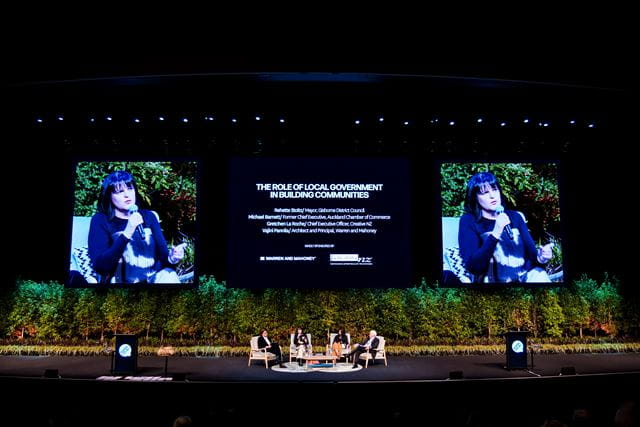
LGNZ’s SuperLocal 2025 was in Ōtautahi Christchurch in July; it celebrated local decision-making by communities, for communities. That idea was explored further in a panel discussion on the role of local government in building community.
Gretchen La Roche, Chief Executive of Creative New Zealand Toi Aotearoa was on the panel, along with Michael Barnett, ex-Auckland Chamber of Commerce CE, and Vajini Pannila, Principal at Warren and Mahoney. Mayor of Gisborne Rehette Stoltz chaired the kōrero.
The panel discussion took place in the context of clear messages about the need for councils to ‘get back to basics,’ understood as pipes and kerbs, with a view to managing rates. The panel offered another perspective on the basics and how arts, culture, creativity and ngā toi Māori build community.
Gretchen La Roche put these things at the heart of community, using the venue as an example.
“Ōtautahi, here is a great example, the rebuild, and how the arts and creativity have been literally moulded into this new city from the ground up. And what a place to visit and be part of, no wonder people are wanting to come and live here and be part of this community. For me, the arts are a fundamental part of this. They allow us to really come together and connect with each other, a healthy community where everyone feels that they can be seen, express their own identity and opinion and feel part of something that’s bigger than themselves.”
In dollar terms, local government investment in the arts, culture and creativity is modest and stable. But it all adds up: the arts and creative sector contributed $17.5 billion to New Zealand's GDP in the year to March 2024 (4.2% of GDP). Gretchen noted the high return on investment realised in the sector.
“We know the arts are a multiplier, every $1 spent on live performance returns $3.20 in community benefits. Te Matatini is a recent example, with about $1.4 million of stakeholder funding contributing $24 million to the Taranaki region in 2025, alongside strong social and cultural benefits.”
Local government leaders make hard decisions within tight budgets but continue to invest in cultural and community infrastructure because they recognise it is foundational to building vibrant towns and cities — places people feel proud to call home.
Mayor Stoltz reflected on the contrast between the discussion at the conference and the conversations she has with people who are thinking about moving to Gisborne.
“All of us have been part of the discussions in the past few days talking about pipes, talking about flood protection, sewage, and focusing on basics. And all that is so important but what we want to add to that mix today is what makes a community. Yes, good roads, good flood protection is essential, but I have never had anyone come to me and say, I want to move to Gisborne, tell me about your sewage system. People would usually say, I’m relocating, talk to me about what you have on offer, what are the things like the libraries, and parks, the museums, the schools, all of that creates community.”
Vajini Pannila believes great public buildings inject life, connection, and vibrancy back into town centres by spaces and places for social connection.
“The built environment is for the community - to use amenities and have shared experiences with their neighbours, to connect with people that they aren't related too or work with. That builds a sense of identity and an overlay of shared values.”
Michael Barnett took the long view, speaking to role of young leadership in changing the way local government serves the community.
“If there is going to be change, there needs to be a partnership with a different why. It’s not about a game of basketball or football or ballet or the arts. It’s about health and wellbeing, it’s about building a community, strengthening families. It’s about building tomorrows leaders, it’s about participating and building knowledge, it’s about fairness and equity, it’s about access to learning and creating more haves than have-nots. A partnership that includes council and community.”
Creative New Zealand has a long history of working with local government decision-makers from around the country. Gretchen La Roche acknowledged this in her opening words.
“We all know local government has a crucial role in investing and supporting arts, creativity, and cultural expression, and we thank you for your continued support. We really value our collaboration to support vibrant, connected, and strong communities across Aotearoa.”
This year we celebrate our 30-year partnership through the Creative Communities Scheme. Together we know supporting arts, culture, creativity and ngā toi Māori is an essential part of thriving communities, a prosperous economy, and a more connected and inclusive Aotearoa.