

02 Nov 2026
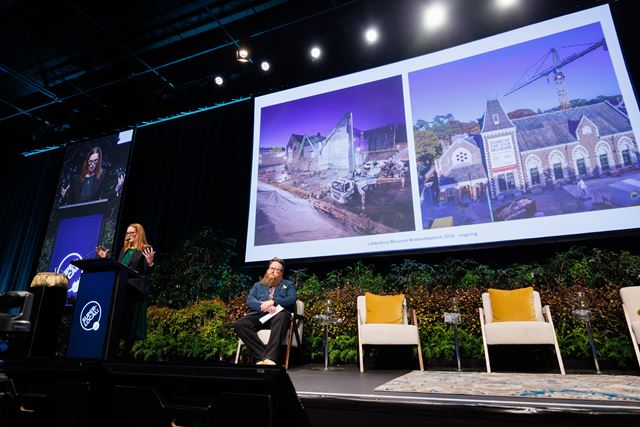
Earlier this month, mayors, councillors, community board members and senior local government staff from across Aotearoa gathered for Local Government New Zealand's SuperLocal conference. Jaenine Parkinson, Chief Executive of Museums Aotearoa, and Jeremy Mayall, Chief Executive of Creative Waikato, both shared a powerful message about the role of arts, culture and creativity in building strong local communities.
They made the case that museums, galleries, theatres and the creative people who bring them to life are vital infrastructure, as essential to thriving places as roads, water and parks. “Let's champion creativity as a strategic asset. Let's champion investment that matches the value being created," Jaenine said.
Investing in creativity for future generations
In her kōrero, Jaenine invited local government to rethink a familiar question. Rather than asking whether arts, culture and heritage are affordable, she encouraged councils to consider how they can create the conditions for creativity to thrive.
Jaenine reflected that creativity, innovation and community confidence are cultivated over time, in the same way as resilience, economic capability and civic trust. She connected this to values local government already holds – stewardship, kaitiakitanga and intergenerational responsibility – and to the way councils invest in water infrastructure, parks and climate resilience for generations not yet born.
She shared three examples of this thinking in action. Christchurch Art Gallery Te Puna o Waiwhetū helped sustain the city's confidence during its recovery after the earthquakes. Matariki showed what can happen when knowledge maintained by Māori communities for generations is recognised and elevated onto a national stage. And the redevelopment of the Sarjeant Gallery in Whanganui – a story of stewardship more than a century in the making – came to life because council, iwi, philanthropists and central government each stepped forward.
She described this as the multiplier effect. Council investment attracts philanthropic investment, council leadership attracts government investment, and growing confidence draws community support, so the outcome becomes much larger than the sum of its parts.
People bring places to life
Jeremy expanded on the idea of infrastructure. He reminded the room that infrastructure discussions often focus on physical assets, but it’s people who bring places to life – the kaimahi and kaitiaki who communicate, connect, build partnerships and mentor the next generation.
“They are the people who arrive early, stay late, build relationships with local communities and businesses, and draw people together. It is those human connectors that strengthen the resilience in a community.”
Jeremy spoke about how communities make meaning through stories, and how those stories help us navigate change. With social cohesion, participation and volunteering in decline, he encouraged councils to see artists and creatives as valued advisors, inviting them into the conversation at the beginning rather than adding them at the end.
Kotahitanga, a philanthropic and local government partnership, commissioned 17 artists to create works inspiring cohesion, connection and inclusivity in response to increased racism at the start of the COVID-19 pandemic. In Kirikiriroa, the BNZ Theatre brought together local and central government, philanthropy, donors, industry and community support, and opened with a performance featuring more than 450 local performers, with multiple generations of families sharing the stage.
Creative Waikato's own artist-in-residence pilot placed 10 artists in communities across the region for a year, leading to significant shifts in social connectedness, wellbeing and connection to place. The stories from that pilot became evidence for a further programme, funded by a local philanthropic trust, which enabled four more artists to work in social housing communities, where tamariki re-engaged with school.
Growing partnerships with creative communities
Both Jeremy and Jaenine saw the current period of change in local government as an opportunity to strengthen partnerships with creative communities and shape a more vibrant future together.
Jaenine encouraged councils to use their collective voice to champion creativity as a strategic national asset, not only their own museum, gallery or festival. Because the benefits of cultural institutions are shared nationally, through identity, tourism, education and community wellbeing, she called for a stronger partnership between local government, iwi, philanthropy, communities and central government. “Make the case that the museums, galleries, heritage places and cultural institutions councils steward are not local amenities. They are part of the infrastructure of a successful nation.”
Jeremy invited councils to look to the regional enablers and local creative organisations already driving activity in their communities, and to consider how working alongside them could build capability across the local creative ecosystem. He also encouraged leaders to make more time for creativity in their own lives, and in the lives of the people they work with and lead. “That small regular moment of singing, or dancing, or creative connection could be the catalyst for positive change and future success.”
Every year, local government invests between $500-600 million in arts and culture, which not only contributes to a sense of place, but also acts as a key lever for economic growth. Arts, culture and creativity are an essential part of what makes our towns and cities places that people want to live in, visit and belong to.
Read about Local Government's role supporting arts and culture in our communities