

28 Sep 2026
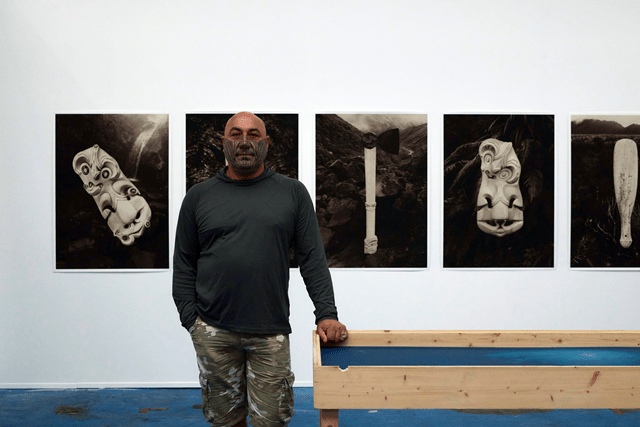
New Zealand’s export permits for 24 carved taonga arrived the day before they left Aotearoa. The French import permits arrived on departure day. The works are now at the 18th Lyon Biennale. For master carver and contemporary Māori artist Rangi Kipa (Te Āti Awa, Taranaki, Ngāti Mutunga, Ngāti Tama), it is a major presentation of his work.
The taonga contain materials whose movement across borders is regulated under CITES, an international agreement designed to protect threatened animals and plants. For Māori, those rules can also affect the ability to carry and share taonga and continue the practices connected to them.
That became visible at the Festival of Pacific Arts and Culture in Hawai‘i in 2024. Taonga intended for display could not enter the United States, so photographs of them became the exhibition instead. Rangi, Pena Makoare, Ngahina Hohaia and Sian Montgomery-Neutze wore “Permit Declined” lanyards, making the missing taonga part of the story.
Rangi remembers seeing Pacific people wearing plastic taonga because they could not travel with their ancestral ones. He and others keep pressing for change, he says, so the next generation will not have to do the same “heavy lifting”.
Rangi and Pena have worked for decades to reclaim Māori practices connected to whale materials. Māori artist and advocate Bonita Bigham (Ngāruahine, Te Ātiawa) joined the kaupapa after a mass whale stranding on the South Taranaki coast in 2018. The kōrero about recovering and using material from the stranding led her to look more closely at what happens when Māori carry taonga overseas.
Bonita supports protecting threatened species. She is concerned that the rules do not adequately recognise the cultural reasons people travel with taonga. She says whānau may not realise a treasured taonga could be confiscated at a border.
“It’s a real risk that our people run all the time,” she says.
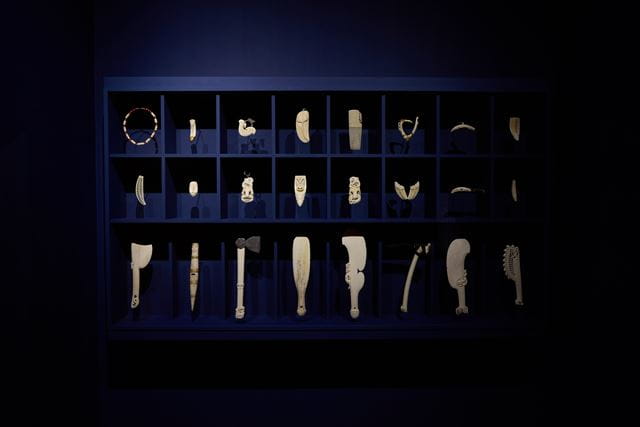
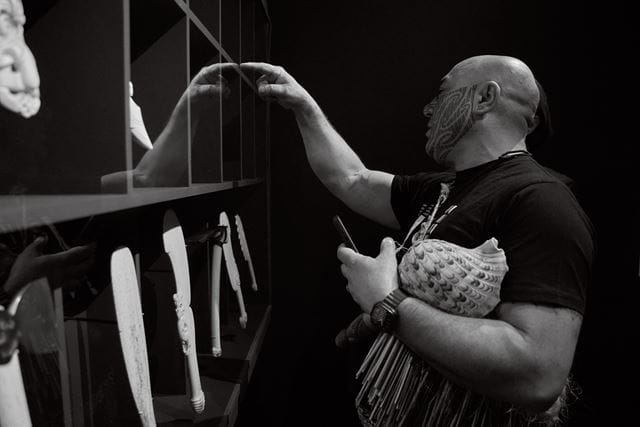
In Lyon, the smaller carvings are displayed at the Musée d’Art Contemporain de Lyon. A Hoeroa is presented at Les Grandes Locos, where Rangi is carving locally sourced bone and talking with visitors about his kaupapa alongside Dr Lisa Renard.
“Whakairo is not simply an art form, it is a knowledge practice,” Rangi says. Through carving, he shares whakapapa, customary relationships with marine mammals and the meaning these materials continue to hold for Māori. He says whale teeth have long been a symbol of arikitanga, or chiefly standing, across the Pacific.
Getting the taonga to Lyon took the work of many people and organisations. Alongside the artists and advocates, the presentation has involved Toi Māori Aotearoa, the Govett-Brewster Art Gallery, the Office for Contemporary Art Aotearoa, DOC, the New Zealand Embassy in France and the New Zealand Cultural Diplomacy International Programme. Support from the Cultural Diplomacy International Programme made it possible to hand-carry the taonga to Lyon and for Rangi to undertake his carving residency there. Creative New Zealand has supported the artists’ international participation and their longer-running work with DOC on CITES.
In November, Bonita will attend the CITES Standing Committee meeting in Geneva alongside DOC representatives. The committee will consider a paper on the participation of Indigenous Peoples and local communities in its processes, including the movement of ceremonial and cultural objects containing protected materials. Bonita has taken this kaupapa into international discussions for several years. She feels momentum is growing, while recognising that the paper has not yet changed what happens to people travelling with taonga.
“My ideal, my dream is that there is some mechanism by which we are able to travel with our taonga without the risk of having them confiscated within CITES countries,” she says.