


04 Jun 2026
Before the muka is softened, before the feathers are carefully laid, before a kākahu ever reaches a gallery wall, there is another part of the work most people never see.
The harvesting. The stripping. The washing. The pounding. The smell of paru on your hands.
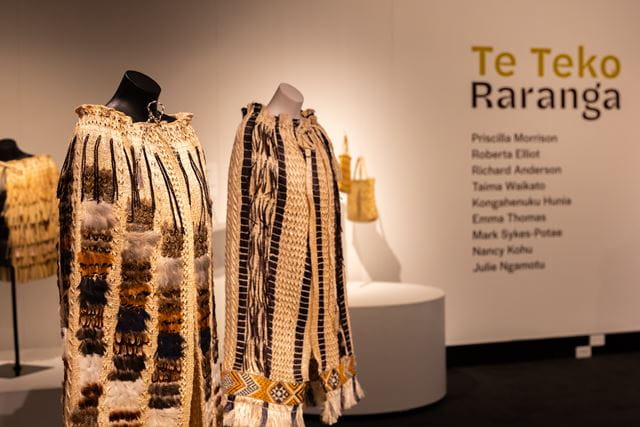
Inside the newly reopened Whakatāne Art Gallery, the works of Te Teko Rōpū Raranga sit proudly within the wider exhibition suite celebrating Ngāti Awa heritage and tuku iho. Cloaks, muka and finely woven pieces stand out beneath gallery lights. The beauty on display is easy to see. What it took to get there is not.
"You want to make a kete? Okay, come along, we're going to go and get some flax first. It doesn't just turn up on your table," says Kaiwhatu Mark Sykes-Potae. "You've got to go back to the pā harakeke."
For Mark, the finished piece is only one part of the story. "The stripping, the mirimiri, the washing, everything else, is the unseen part of making kākahu."
The exhibition brings together works created by members of Te Teko Rōpū Raranga, a collective of weavers who gather regularly at the Te Teko War Memorial Hall. Guided by respected kaiwhatu Priscilla Morrison, the group has quietly become a place where mātauranga, practice and relationships are shared.
“It’s not a kura, it’s not a school,” Mark says. “It’s just a group of weavers who come together.”
Members range in age from their 50s to their 80’s. Some have been weaving for decades, while others are just beginning their journey, and while they’re open to teaching new people, they think it’s just as important for weavers to sharpen their own skills.
“We’re not being exclusive, it’s just important the people who are there feel comfortable.”
The works featured in the exhibition are predominantly traditional muka and feather kākahu, made using methods passed down through generations. Muka is prepared by hand; natural dyes are used, shells are used to scrape and soften the fibre and harakeke is harvested carefully and respectfully. “There’s nothing we don’t do that our tūpuna didn’t do,” Mark says.
Working with harakeke also changes the way weavers see the world. "When you're driving around, you won't be looking at the mountain or the river. You're going to be looking at the harakeke."
Mark laughs when he explains the term weavers use for it. "We call it flax eyes."
What starts as weaving often becomes something deeper. Gathering materials means spending time in the taiao, learning where to harvest, how to care for the plants and understanding the relationship between the work and the environment it comes from.
"You've got to go and get yourself dirty."
The materials themselves often become part of the sharing culture within the group. One weaver may bring materials gathered from the coast, another from inland areas. "We all exchange that sort of knowledge."
Mark is one of two male weavers within the exhibition, his own journey began unexpectedly in the mid-1990s. “I made a little putiputi one day in 1995, and that was when my journey started.”
Now in his seventies, he sees weaving not only as an art form, but as something that gives people purpose, connection and wellbeing later in life.
Knowledge continues to be shared through wānanga and gatherings across Aotearoa, where hundreds of weavers come together to learn from one another. "When you're teaching, you're emptying your kete. You need to fill it for yourself, too."
Back inside the gallery, the finished works sit quietly beneath the lights. Visitors see the beauty of the muka, the detail of the whatu, and the softness of feathers and fibre. What they do not always see are the muddy boots, the shell scraping muka, the harvesting, the preparation and the years of practice behind every piece.
For Te Teko Rōpū Raranga, that unseen work is simply part of the process. It's the work that happens before the gallery lights, before the exhibition and before the finished kākahu tells its story.