


29 May 2026
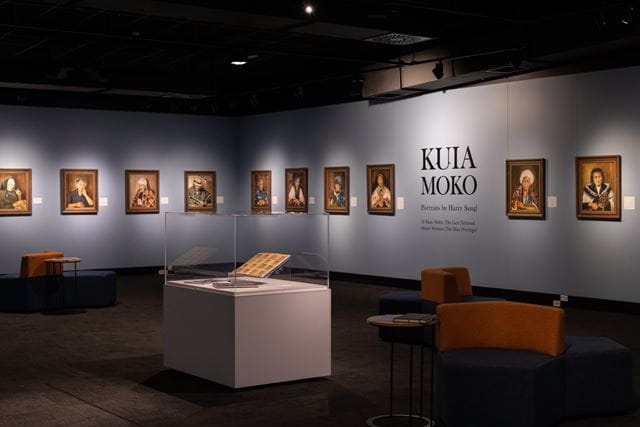
For more than 25 years, they sat in storage. Boxed, protected, but unseen.
Thirty-four portraits of kuia with moko kauae, painted by artist Harry Sangl in the 1970s, had travelled, been held in a trust, and eventually found their way into a Wellington warehouse. For a long time, they were away from the communities and whenua to which many of them belonged.
Now, they have returned to Whakatāne.
For Mark Sykes-Potae, former manager of the Whakatāne Museum, their return is not just about an exhibition. It is about mana, memory, whakapapa, and the responsibility of caring for taonga properly.
“I think they have found their mana again,” he says.
The portraits form Kuia Moko – A collection by Harry Sangl, one of four exhibitions reopening the refreshed Whakatāne Art Gallery. The suite celebrates Ngāti Awa heritage, bringing together taonga, artists, weavers, kuia, tamariki and mokopuna through the shared thread of tuku iho.
But inside the Kuia Moko exhibition, there is another story quietly unfolding, one about return.
Sangl painted the 34 kuia in the early 1970s, travelling through the Eastern Bay of Plenty and other parts of the North Island. Alongside the portraits, he recorded what he could about each woman. Who they were, where they were from, and the kōrero shared with him at the time. For this exhibition, the team deliberately chose to keep his original words.
That choice was not without complexity. Some whānau have since come forward with mixed reactions to what was written or how their kuia were represented. Mark understands that. “That was what happened in those days,” he says. “He would visit the kuia, have a kōrero, do some sketches apparently, and then paint them. So that’s what he recorded.”
Rather than closing the story, the exhibition has opened it. Whānau are coming in, recognising faces, correcting names, adding layers. The gallery has become a place where the written record meets living memory.
“We’re happy to listen to the whānau now and find the connection to them,” Mark says.
The collection has had a long journey. In the early 1990s, the Kuia Moko Trust was established, with support from Brierley Investments, to help ensure the portraits remained together in Aotearoa and could continue to be shared with communities around the country. Under the care of the trust, the collection toured galleries and marae before eventually going into storage. Conversations with museum professionals and kaitiaki, including the late Hema Temara, helped ensure that the collection remained together and ultimately returned home. “It was important that they stay together always,” he says.
When the portraits finally came home to Whakatāne in 2020, the care around them was immediate and instinctive. Mark says the team, many of them Māori, already understood the tikanga needed in how the kuia were handled and stored.
“We were very aware of how we would hang the collection in the storage rooms,” he says. “Not above each other, making sure no one was above anyone else.”
That detail matters. It speaks to the kind of knowledge that is not always written into policy, but is carried in people, practice and place.
For Mark, this is part of the wider importance of regional leadership in the arts. As Creative New Zealand signals a stronger shift toward regional voices and decentralised ways of working, Whakatāne offers a clear example of why that matters.
“The expertise is already here. The regions have a lot of untapped talent,” Mark says.
In this case, the knowledge was not just curatorial. It was cultural. It was relational. It was knowing how to hold taonga, how to make space for whānau, and how to let the kuia return with dignity.
Mark says Whakatāne is a small regional place, but it is holding exhibitions of national significance.
The return of Kuia Moko shows what can happen when stories are held close to the communities connected to them. Many of the kuia are from this rohe, Ruatoki, Whakatāne, Te Teko and surrounding areas. Their descendants are still here. Their names are still spoken. Their faces are still recognised.
For visitors, the portraits may be beautiful artworks. For whānau, they are nannies, aunties, tipuna. Mark says the gallery gently reminds people of that,. “tThey are someone’s family.”
Photography is allowed for whānau, but the team encourages care and awareness, especially when images are shared publicly. For Mark, the room itself carries something.
“To be in the room with them, which we’re lucky to do by ourselves sometimes, there is a beautiful mauri that goes around that room every time.”
That mauri is perhaps what was waiting all those years in storage. Not lost. Not gone. Just waiting to be returned to the right place.
And now, after decades away, the kuia are back in the light, not as objects on a wall, but as people, as whakapapa, as reminders of what endures. “I think they’re in the right place,” Mark says.