

24 Apr 2026
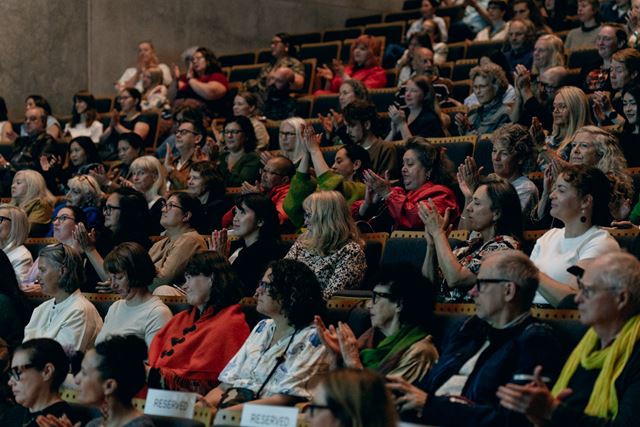
Throughout March, All in for Arts: He waka toi e eke noa nei tātou brought together communities across Aotearoa; in Tāmaki Makaurau Auckland, Ōtepoti Dunedin, Kirikiriroa Hamilton, Te Whanganui-a-Tara Wellington, Tūranganui-a-Kiwi Gisborne, and Ōtautahi Christchurch.
Over coffee and kai, each event showcased inspiring perspectives on the power of creativity from artists, rangatahi, journalists, mayors, politicians, and business leaders. In partnership with The Arts Foundation Te Tumu Toi, with support from the Chartwell Trust and Stuff, audiences heard about the power of creativity to shape identity, connect people, and build a thriving future for art, artists and all New Zealanders. Here are some of the key themes that emerged across the 2026 tour.
Creativity is woven into who we are, and who we can become
Across the motu, speakers returned to the idea that creativity is identity itself. For Māori and Pasifika speakers in particular, art is inseparable from whakapapa, from language, and from the very act of being.
“Art is not separate from life. It is woven through everything… our stories begin between Ranginui and Papatuanuku, and from their children come the winds, the forest, the rivers, and with them, our language, our music, our movement, our carving, our weaving.” Kirikiriroa Councillor Anna Casey-Cox, Hamilton, citing colleague Councillor Maria Huata
“Storytelling is old and fundamental to who we are as human beings, not confined to theatres or galleries. Storytelling is embedded in the way that we live.” Juanita Hepi, Artist, Storyteller, Lecturer and Researcher, Christchurch
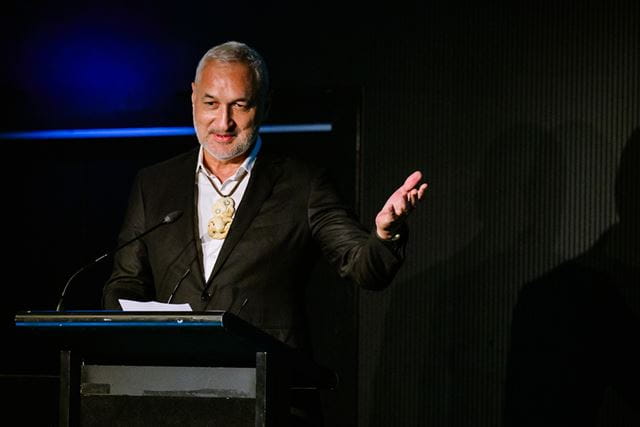
For broadcaster Mike McRoberts in Auckland, this connection to identity was deeply personal. His journey of learning te reo Māori showed him that creativity is also about becoming. “Te reo Māori has opened doors for me. Yes. But more than that, it opened me. It gave me another way to understand the world, another way to connect with people, another way to feel home.”
The arts as healing, refuge and resilience
A thread across the tour was the number of speakers who came to creativity not as a first career choice, but as a lifeline. Whether escaping loneliness, processing trauma, navigating disconnection from culture, or managing anxiety, speakers described art and creativity as the thing that helped heal them.
“Out of disconnection and confusion, out of the pain of not belonging, I eventually found refuge in music, in art, in creativity. I discovered not just an escape, but a home.” Vallé, Songwriter and performer, Christchurch
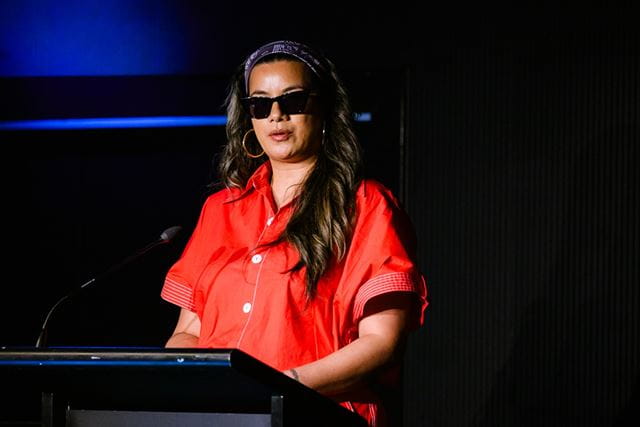
“Creativity took my private pain and made it like a shared language between us. That one act - putting words to what hurt - became my career, a calling, a compass.” Ladi6, Musician and Businesswoman, Auckland
“All I knew for quite a while was how to be or feel the sense of smallness and thought that my anxiety would define who I was. That was until I found the arts.” Lehali, Singer, Artists and Rangatahi Advocate, Hamilton
Art as infrastructure - embedded in place
Speakers challenged the idea that art belongs in galleries and theatres alone. Mayors and councillors spoke compellingly about what happens when creativity is embedded into infrastructure from the very beginning.
“Too often, infrastructure is only thought of as functional. Roads, water, and pipes. But you can only achieve something special if you partner with artists right from the very beginning - not as an add on, but as partners from the start.” Mayor Rehette Stoltz, Gisborne
“Policies like art and infrastructure matter. Allocating up to 1% of infrastructure budgets embeds creativity into everyday spaces, ensuring art is something we live with every day.” Councillor Anna Casey-Cox, Hamilton
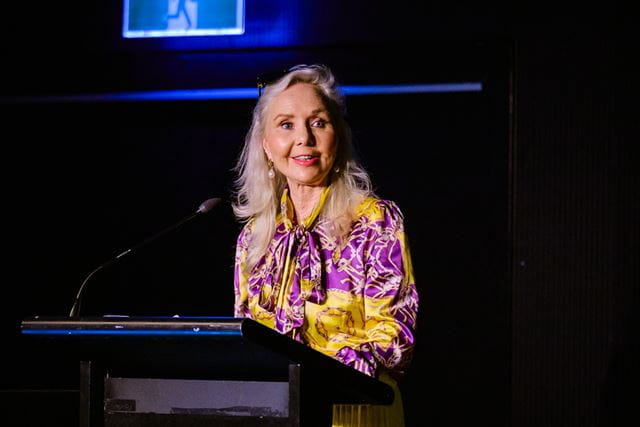
In Auckland, Deputy Mayor Desley Simpson articulated a bold ambition: “I want Auckland to be the greatest cultural city in the Southern Hemisphere.” Pointing to new public artworks and the restored Auckland Art Gallery, she reminded the audience: “When we care for our cultural institutions, we are really caring for our people.”
Rangatahi and the case for investment
One of the most consistent calls to action across the tour was the need to invest in young people both to support individual careers and to ensure the next generation sees themselves reflected in the arts and believes that creativity is for them.
“Representation for young people and young indigenous peoples can help us see ourselves showcased in ways we never thought possible and empowers our rangatahi to chase their dreams.” Lehali, Singer, Artists and Rangatahi Advocate, Hamilton
“Not every rangatahi is going to shine in academics or sports, but every rangatahi has the ability to create.” Kamoe Paki, Artist, Gisborne
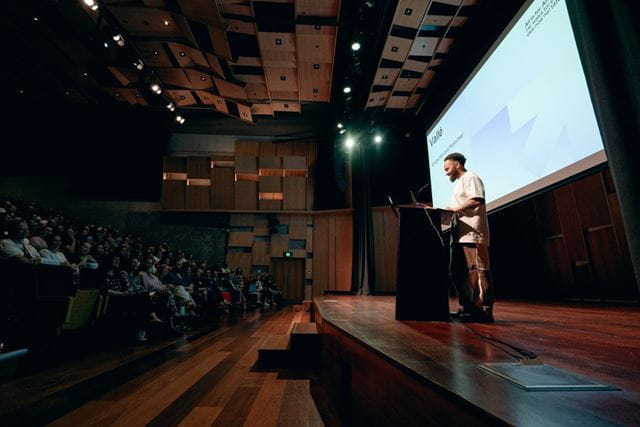
In Christchurch, songwriter Vallé spoke movingly about the teachers who recognised something in him early. “To the teachers, educators, parents, and mentors in this room: never underestimate your influence. See the potential and take the risk. You never know what that choice might unlock.”
Creativity versus the machines – the human case for the arts
With consistency, speakers turned to the question of artificial intelligence and what it means for human creativity. Rather than dismissing the challenge, they used it to make their most powerful arguments yet for why the arts matter.
“AI can increasingly do what once required human effort – the analytical, the procedural, the predictable. What it cannot do is feel. The unexpected connection, the intuitive leap, the creative choice born from lived experience – that is precisely where human value lives.” Meg Williams, CEO, World of Wearable Art, Wellington
“The technology can’t do it on its own… what we are hiring for is passion, creativity, imagination, and hunger.” Sinead Boucher, Stuff Owner, Auckland
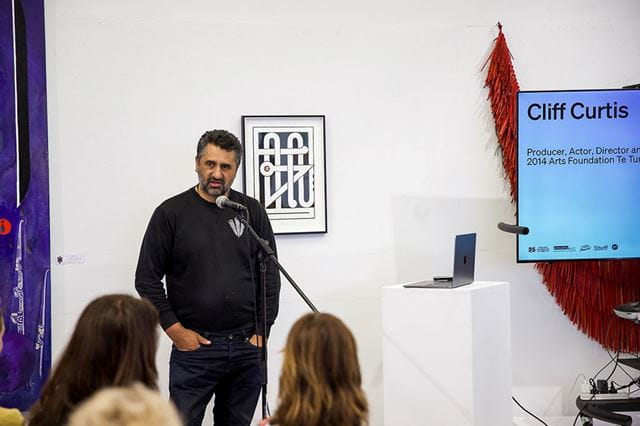
In Gisborne, actor, and producer Cliff Curtis offered his own framework, proposing creativity as an economy that can never be depleted: “What is infinite? What can we have that will never run out? That stuff between your ears.” In an age of automation, he suggested that creatives may be the most future-proof people in any room.
Storytelling as power, and the ongoing fight for whose stories are told
Some of the most powerful speeches of the tour confronted head-on the question of whose stories get told, who gets to tell them, and what it costs when voices are left out. Juanita Hepi, A Christchurch based artist, storyteller and lecturer, gave a powerful warning about culture and national identity;
“If you can control culture, you can control imagination. And if you can control imagination, you can control the story a nation tells about itself”
In Wellington, Pacific arts leader Nina Nawalowalo wove together her own family history, her father, the first Fijian lawyer to graduate from Victoria University; her mother, an English nurse; their interracial marriage in 1960s Wellington, with a call to remake the dominant narratives we inherit. “What is created can be changed… I choose to be the author of my own truth.”
Writer Te Awhirēinga Heperi, speaking in Dunedin, issued a direct challenge to any who might stay quiet. “Creative silence is the tolerance of societal injustice. Your silence makes space for voices that have been platformed for far too long. But your creativity makes space for the voices that deserve that very platform.”
And in Dunedin, writer Lloyd Jones made an urgent case for reading, warning of a deepening crisis in New Zealand’s relationship with literature and calling for a national commitment to get behind it: “If you want an intelligent population and one that’s original, reading is so important.”
Across six cities, the message was consistent: creativity is foundational to life in Aotearoa New Zealand. Whether through funding emerging rangatahi artists, embedding creativity into civic infrastructure, protecting spaces for indigenous storytelling, or pushing back against the flattening power of technology, the ask is the same: value what artists do, support them to create, and build the spaces and systems that let everyday creativity flourish for all New Zealanders.
As actor and writer Tuakoi Ohia reminded us in Auckland, “When your soul is feeling empty, you read a book, you listen to music, you listen to stories. When a human needs beauty, inspiration, or understanding, you call us – the artists.”
Jessica Palalagi, General Manager of The Arts Foundation Te Tumu Toi, closed the event with three clear calls to action. First, vote — enroll early, check your details, and make sure your voice is heard. Second, value — reflect on what matters most to you and the kind of communities you want to help shape. And finally, support — give what you can, where you can, because collective effort creates meaningful change.
All in for Arts has been running since 2020 as a partnership between Creative New Zealand and The Arts Foundation Te Tumu Toi.
You can listen to the all the speeches on Spotify on the All in for Arts podcast