


19 Mar 2026
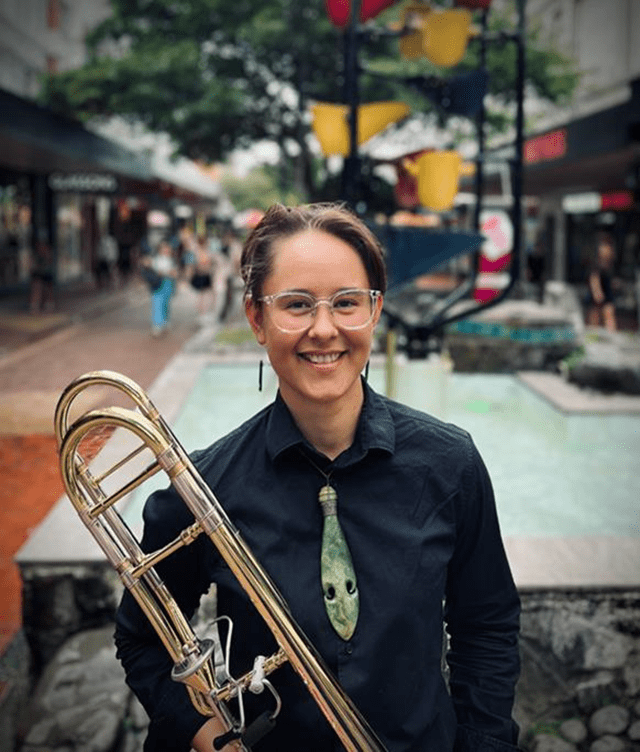
“Believe that things can happen,” Natania Ngawhau’s advice for aspiring musicians.
For more than 30 years, the Jack McGill Scholarship has helped New Zealand musicians take up opportunities they might otherwise have to turn down. Each year, the scholarship supports up to two promising musicians, aged 20 or over, to study overseas for up to a year. Applicants must have an undergraduate or equivalent in their instrument of choice and a strong track record of achievement.
In its history, more than a hundred musicians have used the funding to access world class training at crucial points in their careers.
One recent recipient on the scholarship is trombonist Natania Ngawhau, a young musician whose musical journey has taken her from rural Kaikōura all the way to New York City.
Natania is currently studying the first year of a Master of Music in Orchestral Performance at the Manhattan School of Music. The programme takes only 35 students, a year and has musicians from New Zealand, Romania, Germany, Italy, Spain, China and Japan and more.
Natania grew up in Kaikōura in what she describes as a “very non-musical background,” though her dad could sing and her grandad liked classical music. She started on trumpet at 8 or 9, later moved to trombone in Nelson, had strong teachers and joined the winning Nelson Brass Band. After high school, she planned to join the army, but when she was told she would not have time to keep playing trombone, she made the hard choice to study music instead.
Funding
The Jack McGill Scholarship enabled Natania to study in New York, paying more than half her yearly tuition. In addition, she also receives a scholarship from the School of Music, and support from the Dame Malvina Major Foundation, The Waikanae Music Society Charitable Trust for Young Musicians, the Alex Lindsay Trust and the Deans Endowment Trust, which help with her living costs.
The course focuses on orchestral playing, auditioning and section skills, alongside academic work. Natania has weekly lessons with Colin Williams, associate principal trombone of the New York Philharmonic, whom she calls an “incredible man… crazy player, amazing teacher” and a “super nice dude.” After rebuilding his embouchure following a lip injury, “if you have a problem… he’ll have a solution.”
Most of her playing is in a low brass section of two tenor trombones and a bass trombone, rehearsing three to four times a week with coaching from New York Philharmonic brass players.
Natania said she found the environment intense at first but after a while she settled in in and truly appreciates the hard work that everyone puts in. She describes her fellow students as “fantastic” and says she learns a lot from them.
She also plays in a trombone quartet that recently recorded for a summer festival and is coached by the principal trombone of the Metropolitan Opera, who she describes as an “incredible dude.”
Career ambitions
“My ambition is to join an orchestra. That is like the life I want.” She also wants to teach, saying she finds it rewarding to “watch kids get excited about music.”
She is realistic: “It is extremely hard to win a job… and I do not think it is one that you can be picky about. While she hopes to one day play in the NZ Symphony Orchestra, she expects she will take the first job that comes up once her studies are finished. “I was looking at one in Finland the other day.”
How to support the arts?
“For individuals,” Natania says, people can help musicians “going to concerts, taking your friends to concerts, buying tickets, supporting the artists.”
For people who want to contribute financially, she suggests donating to fundraising efforts such as Boosted, a New Zealand arts crowdfunding platform. It helps creatives raise money for their projects by connecting them directly with supporters.
Always keep an eye out for how to directly support artists through donations, memberships and subscriptions – if it isn’t obvious, don’t be afraid to ask groups or individuals directly.
She also mentions programmes like Arohanui Strings and Brass, where she once worked. “If you have got old instruments lying around… they need instruments to play on.” She donated an old trumpet herself.
Supporting new work matters too. “Commissioning new works kind of creates work for composers and then performers as well.”
She also keeps donors informed through a newsletter. “I like being able to share stuff with my donors so they know what I am doing with their money.”
Advice for aspiring artists
For young musicians considering overseas study, Natania says they should: “Believe that things can happen.”
“You cannot just sit there and wait for them. You have to make your own opportunities… apply for funding, apply for all of the things.”
She was encouraged by her New Zealand teacher to give overseas study a go. She says it gets harder to fundraise in later years of study. “A lot of other students have struggled with their second year of their master’s due to lack of funding.” Living costs in New York are high, but she is gunning to be a Resident Assistant for a year of free room and board.
“It is hard for everyone, but especially for international students, because we cannot work either,” she says.
If you are interested in contributing to Creative New Zealand’s Music Scholarships as a patron, contact renee.casserly@creativenz.govt.nz Long term support such as donations, patronage and bequests can make a transformational difference, creating stable funds that allow future artists to thrive.
Find out more
- Learn about the Jack McGill Scholarship and other opportunities for musicians
- If you would like more information on our Music Scholarship programmes, please contact renee.casserly@creativenz.govt.nz
- See Arts crowdfunding platform, Boosted