

02 Mar 2026
For visual artist Roberta Queiroga, the path to painting has been anything but linear. Trained as an architect, her creative journey spans continents, disciplines, and cultures, creating a practice rooted in memory and belonging. In 2024, she received support from Creative New Zealand’s Development Fund for Artists and Practitioners, backing her artistic growth.
Born in Brazil, where her great-grandfather arrived from Portugal, Roberta has called Aotearoa home for 25 years. Having lived across four continents, she has a keen sensitivity to space and place, and a deep respect for culture that continues to shape her work. Highly autobiographical and immersive, her art explores movement, memory, and materiality, creating a dialogue between artwork, viewer, and space.
Architecture gave her discipline, precision, and spatial awareness, but it was a long pause from art that defined her practice. When Roberta arrived in New Zealand, she focused on building a a new life, putting painting aside for 18 years.
“When I moved to New Zealand, I was adapting, settling, and building a life as a solo immigrant. There were challenges that led me to put art aside. I once painted daily and never missed exhibitions, suddenly stopped while life took over,” Roberta says.
Yet during that time, she absorbed new cultures and experiences. When she finally returned to her canvas, it was with urgency and freedom. Her work moves between intuition and rationality. Sometimes a memory, word, or philosophical idea sparks a piece; other times, the first gesture on canvas reveals its direction.
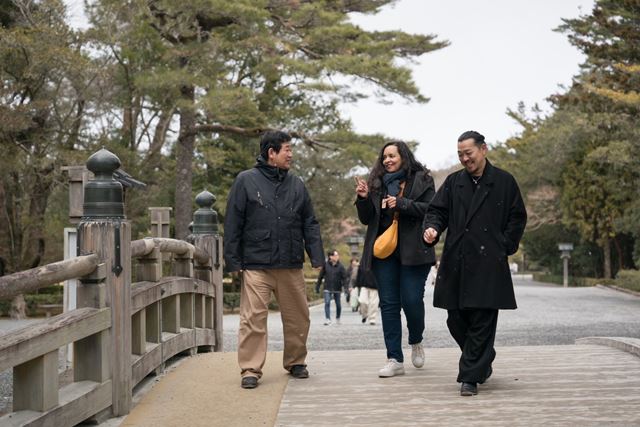
Roberta’s first experience with Japanese calligraphy, shodō, began years ago and was further enriched during a recent residency to Japan. During the trip, she participated in tuakana–teina mentoring with renowned calligrapher Ito Junichi.
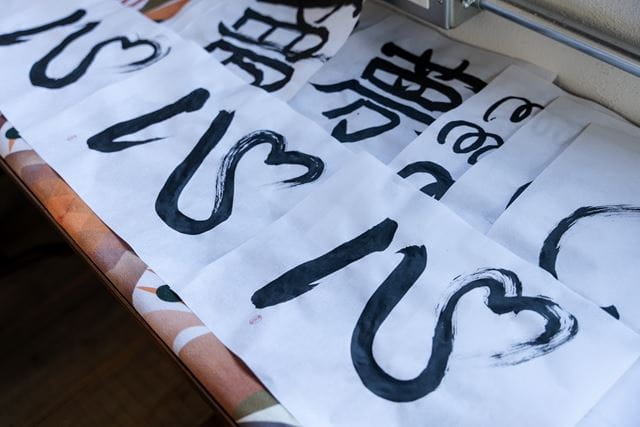
“I was first exposed to shodō as a student in Japan and I became fascinated. During that year, I absorbed as much as I could—training, observing, visiting exhibitions—but never felt free to fully include it in my art, worrying that as a gaijin (foreigner), I wasn’t supposed to attempt it,” she says.
“Working with Ito changed that perspective. He encouraged me to explore Shodo on my own terms. Ito approaches the brush with incredible reverence and patience. Watching him, I became more attuned to the care of the tools, his discipline, and the shikata. I often work symbiotically, applying paint with a myriad of tools or my hands directly onto the canvas rather than just brushes. The experience also reminded me of the importance of slowing down and taking moments to appreciate tea or matcha, no matter how busy the day,”
Together they experimented with blending acrylic and sumi-ink, producing collaborative works that merged distinct styles into one visual language. Their joint exhibition, DUO, revealed the power of trust and shared creativity, as two different energies harmonised on canvas.
Plans are underway to take this dialogue back to Japan. Roberta hopes the Japanese audience will take away an honest conversation between shodō, contemporary painting, and her personal explorations.
“I want Japanese audiences to sense the respect and curiosity, in which, I’ve engaged their tradition, while also recognising that what we’ve created a dialogue between Ito’s practice, my own explorations, and the intersections where they meet.”
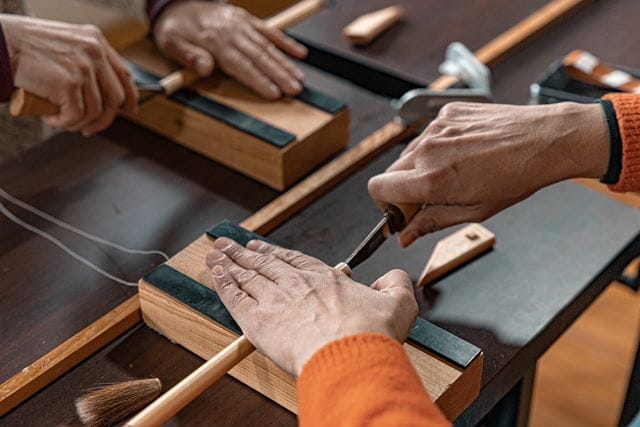
Roberta saw the trip as the perfect blend of cultural exchange, leaving her with tangible and intangible gifts. Shodō taught her the value of restraint, breath, and presence. Each stroke demanding courage and acceptance. A brush she shaped with her own hands now sits in her studio as a daily reminder of patience, craft, and intention.